An avid reader calls it as she sees it on books, publishing and the written word in general.
Showing posts with label Crime. Show all posts

Tuesday, November 6, 2012

BOOK REVIEW: A Drink Before The War by Dennis Lehane


I’ve heard people describe “muscular prose” before, but I never really understood it until I read Dennis Lehane’s A Drink Before the War. The first book in a series now numbering six, it’s satisfyingly  hard-edged crime fiction with a distinctive voice.
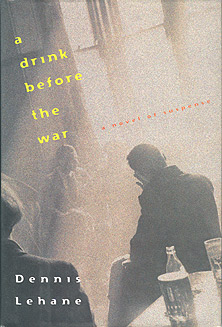
 

The book, Lehane’s first, dates from 1994 and chronicles the seedy side of South Boston, with gangs and violence an everyday occurrence. There’s humour, but this is no comedy; it tends to be of the unrelentingly black variety. Eighteen years and a hemisphere away, I’m in no position to judge if this is an accurate portrait of the times, but it certainly feels authentic. The prose itself is terse, descriptive, at times poetic but painting a sharp portrait of tough times.  If I have a minor complaint, it is that in setting the scene Lehane occasionally gets carried away and has his protagonist phrasing thoughts that are rather too poetic, but as the plot picks up pace this ceases to be a problem.

The narrator, Patrick Kenzie, is a P.I. in the hardboiled tradition. He struggles to pay the rent, probably drinks too much, and has an unrequited crush on his partner, Angie Gennaro. In turn, Gennaro still seems to love her husband, referred to by Kenzie as “The Asshole”, who beats her up on a regular basis. This is one of the things I loved about the book; as in life, human relationships here are seriously complicated. Everyone’s a bit messed up. Even at the end, Lehane avoids tying things up in a neat bow and questions and doubts remain.

The plot itself is tense and satisfying. There is some explosive action as Kenzie and Gennaro go on the run from rival gangs, but the violence never seems exaggerated or cinematic. The “War” of the title erupts, but seems like the kind of thing that could be ripped straight from the newspapers, particularly those of the era.

This is the kind of gritty, well-written, fast-paced book that gives crime fiction a good name. South Boston in the nineties is not a world I’m familiar with, but I enjoyed a visit and I’ll be back for the rest of the books.

Sunday, October 21, 2012

On Comfort Reads and Rex Stout


There are some books that you turn to when your nerves are jangled, when worries press heavily on you or when everything suddenly seems too hard. I think of them as “comfort reads.” No doubt everyone has a different book, but for me it’s the collected Sherlock Holmes. I’m not sure whether it is the orderliness and logic of the solutions, the sense that Holmes and Watson exist in their own little time bubble on Baker Street where nothing ever changes, or the fact that I have been reading and rereading them for years – whatever it is, it works like nothing else to soothe and calm me.

But to my surprise, I recently found another author who has the same effect. Rex Stout is an amazingly prolific and amazingly successful author of the past who has now faded into near-obscurity. His mysteries featuring the obese Nero Wolfe and the wisecracking Archie are my new addiction, and I now take every opportunity to visit that New York brownstone filled with familiar characters, from Fritz the chef to Theodore the orchid man. Happily, as Stout wrote 72 in the series, there are plenty of opportunities.

Let me be clear – the plots are varied, occasionally verging on silly (the special golf club devised to fire a splinter into the wielder’s heart was something of a lowlight). It’s not about the plot. Like all comfort reads, it’s fundamentally about the characters. Both Wolfe and Archie are a product of their time in having quite appalling attitudes towards women, but otherwise they are both fascinating nuanced characters. Wolfe in particular is a study in contradictions, so obese he can barely move but possessed of huge mental agility, wise but at the same time sometimes petty, and generally inclined to favour orchids over people. In contrast, Archie is charming, fun, and owes a lot of his “jaundiced private detective” shtick to Philip Marlowe. The other thing which anchors the books is the relationship between these two. Their mutual attitude verges on dislike much of the time, but Stout makes clear that both harbour a deep affection towards the other (if both would probably die rather than admit it).

But they key to a comfort read is predictability. You know that the characters are not going to grow, they are not going to evolve, they will never move out of that comfortable brownstone. Loose ends will always be tied up neatly. Archie will have fun along the way, and drink large amounts of milk (something I’ve never quite understood). Wolfe will be irritable then finally solve the case, with help from Archie. It’s like visiting a place you’ve been many times before, but always enjoy, and enjoy more because you know what to expect.

Ultimately, a comfort read doesn’t have to be great literature. There is a place for books which make you feel warm and cosy inside and convince you that the world isn’t such a bad place after all. And that is what both Conan Doyle and Stout do.


Sunday, October 7, 2012

BOOK REVIEW: Death Comes to Pemberley by PD James

Logically, if you take two things you like and combine them, you should end up with something you like even more. You only need to look at the stratospheric popularity of YouTube mashups to see this rationale being played out.  The “literary mashup” genre has also taken off recently, from Pride and Prejudice and Zombies to Abraham Lincoln Vampire Hunter, Laurie R King’s Mary Russell series and others. From what I can see, the key ingredient is an enduring literary classic colliding with an unexpected genre.
So two of my favourite things – PD James crime and Pride and Prejudice – should add up to something even more fabulous, right? Unfortunately, I have to report that this theory doesn’t always work. I don’t have any problem with someone playing with a literary classic (in fact, I was quite enthusiastic about the idea) but it seems that adapting someone else’s work is a fraught and troublesome exercise. A balance needs to be struck between being faithful to the original and building upon it, and the modification that will invariably follow from that exercise. To my disappointment, it’s a line that Death Comes To Pemberley seems to fail to walk with any degree of success.
To start with the positive – the short recap of the events of Pride and Prejudice at the start is an unmitigated delight. James does have a few pithy comments to make on the original, such as Elizabeth musing on whether she would have married Darcy if he was not rich. These were the parts of the book that I enjoyed the most.
The plot itself starts out well but quickly descends into implausibility. This wouldn’t be such an issue if the characters themselves weren’t so wooden. James has a fair head start by dealing with characters that readers already know and love, but unfortunately, she has failed to make them her own. At best, they give the impression of actors in a bad movie reading aloud their lines with little conviction. By the end – death for a crime novel – we don’t really care whodunit at all. The court case at the end goes on for far too long and we spend too much time in the head of Darcy, who is so honourable as to be completely uninteresting (I believe the scientific term is “stuffed shirt”). If nothing else, the book proves Austen’s sense in telling the story from Elizabeth’s perspective!  
The Sunday Times quote on the cover describes PD James as “The greatest contemporary writer of classic crime” and it’s hard to argue with that assessment. But ultimately, as James herself admits in her introduction,  mixing a crime story with Ms Austen’s world was always going to be a big ask. Perhaps there’s a fundamental incompatibility or perhaps the problem is that James was simply too respectful of the original and not bold enough. Whatever the cause, it’s hard to deny that Death at Pemberley is one of the less successful examples of the mashup genre.


Saturday, August 11, 2012

AWW BOOK REVIEW: A Few Right Thinking Men by Sulari Gentill

After you’ve closed the cover it can take a few days to pull free of a really fascinating story. You find yourself musing on the plot, the characters and the setting, and daydreaming about it in absent moments. For all my love for the crime genre, this doesn’t usually happen with crime novels – the main reason that they are my preferred weekday read. However, Sulari Gentill’s historical crime novel A Few Right Thinking Men absolutely captured my imagination.

So what was so unusual about this book? First off, there is the setting. I’ve always thought that Australian history was under-utilised as a setting for historical crime novels, and the thirties are probably one of the least-known eras of Australian history. I would have thought that they are a period not exactly ripe with dramatic potential, except that Gentill so clearly proves me wrong. The rising tensions between the communists and early fascists, played out in the context of a squattocracy with conservative leanings and a bohemian fringe with communist sympathies, make for a gripping backdrop. It’s extra fascinating because you can recognise a cultural discourse that still continues today between left and right in this country.

But of course a setting is nothing without a plot and characters, and these are especially key for crime novels. On the point of characters Gentill really excels. The main character, Rowland “Rowly” Sinclair, is a member of a wealthy squatting family, turned artist. He’s rejected the values he grew up with and almost succeeded at becoming a through-and-through bohemian – except that he still feels the tension of trying to fit in with the artists who have come to live in the family manor. His relationship with his family is hardly easier, as he tries to maintain his independence while not irreparably damaging the relationship. A part of him still seems to long for the gracious country lifestyle of his brother Wilfred, although the two brothers disagree on almost everything. When a murder in the family brings politics into the mix, Rowland and Wilfred seem likely to end up on different sides of the brewing conflict.

In terms of plot, this is perhaps not a classical crime novel. While it starts out with a murder, it soon devolves into an examination of the murky politics of the time. The murderer is discovered in the end, but the book avoids the trap of tying up all the loose ends with a too-neat bow.  However, I do wonder if the plot suffers a bit from the paradox Gentill identifies in her comments at the back of the book: “I found I didn’t need to fictionalise the events of the era…the facts were fascinating and ludicrous enough.” The truth may be stranger than fiction, but ironically it is sometimes less believable than pure invention. While the setting was impeccably drawn and Gentill’s historical research meticulous, I think that the book may have benefited if she took more creative licence with the facts. A final confrontation with Campbell, in many ways set up as the villain of the piece, would have given weight to the ending.

The thing I enjoyed most about the book, the thing that kept me thinking about it for days, was that it gave me an insight into Sydney in the thirties that I’ve never had before. You can read a list of facts, even a historical document, but to get that sense of what it was to be there – that idea of how people thought, acted, the politics of the day, the class divisions at work – you need a book like A Few Right Thinking Men. This is where fiction has a huge advantage over non-fiction, yet the best books still manage to educate as well as entertain. The phrase “bringing history to life” is overused to the point of cliché, but this is truly what Gentill manages. It’s a fantastic achievement.

Thursday, March 22, 2012

AWW BOOK REVIEW: Sharp Shooter by Marianne Delacourt

 Cover lines which refer to bestsellers are a risky strategy, creating expectations which the novel itself may find hard to meet. Marianne Delacourt's Sharp Shooter raised my eyebrows with the cover line 'Introducing Tara Sharp, a new, kick -arse crime fighter for fans of JANET EVANOVICH.' (yes, capitals in the original). It's a bold move to refer to the woman who basically invented the kooky-crime-romance genre, although I presume the marketing department is to blame rather than the author. Unfortunately, while Sharp Shooter is a competent light-crime novel, it suffers in the comparison.

One area where Evanovich is particularly strong is keeping up the pace. In contrast, Delacourt introduces all her characters at a leisurely speed and with little urgency before the story actually begins. It’s not until page 39 and Chapter 7 when fledgling 'paralanguage agent' Sharp is hired by a dodgy lawyer with mafia connections that things start to get interesting. The first six chapters consist of background and introduction and if I hadn't been reading with a view to writing a review, I would have been tempted to put the book aside. In particular, I didn’t find Sharp engaging as a character in these early chapters. There was a great deal of what I thought was rather laboured slapstick (for example, I found the episode where she spills her drink on a potential client painfully unfunny.) Still, sense of humour is a personal thing and other readers may not have the same reaction.

Once the story gets going the book improves markedly and I liked the fact that it is set in Perth, obviously a city that Delacourt knows well. I think she also succeeded in maintaining a genuine Australian tone throughout, avoiding the risk of transplanting an essentially American story. The love interest is plausible and Tara Sharp also becomes more likable as the story progresses. Some of the more annoying minor characters fade out of view (the wise teacher speaking in broken english is one I particularly wanted to strangle).

One other aspect of the book that seemed rather underdone was the supernatural element. Sharp's ability to read auras is certainly an original plot device, but seems to me to be rather useless. As far as the story goes, an experienced reader of body language would end up with exactly the same information, and we hardly need descriptions of their auras to work out who are the bad guys. Instead, the aura reading becomes something of a sideshow, an alternative method of describing a character (eg. “Grassy green aura” instead of “tall with blue eyes”). It also makes the comparison with Janet Evanovich even more puzzling – while her new series does include a supernatural element, her hit Stephanie Plum series does not.  

Still, even taking the above into account, I did think it was competent and relatively entertaining, with a number of good points. It’s possible than fans of Janet Evanovich will like this book, if they are looking for something in a similar genre. I do think it could have done with some further thinking and editing, but then I’ve thought that about the last few Janet Evanovich books as well. I think it’s unfortunate that that cover line created such high expectations, because read on its own merits this is a competent and enjoyable Australian contribution to the light-crime-paranormal genre.

Sunday, May 8, 2011

BOOK REVIEW: Murder in the Bastille by Cara Black

 For a writer, crime novels come with their own particular challenges. As well as the usual aspects of characterisation, narrative voice, and plot, there is the additional task of posing and answering the question “whodunit?” The writer must provide enough information to give the reader a fair chance to solve the mystery, yet hide the essential clues in plain sight.  It’s the literary version of the magician’s sleight of hand – the trick is to get the audience focussing on the flimflam so that they miss what is going on elsewhere. It’s only when the magician reveals how the trick was done that we cry “Of course! The butler did it!”
I’ve been thinking about the art of the crime novel while reading Murder in the Bastille by Cara Black. This is the second novel of Black’s that I have read, and both have left me feeling unsatisfied. I’m not sure Black manages to balance giving the reader enough information, but not too much. With both novels, I turned to the final chapter thinking not “Of course!” but “Where did that come from?” It’s not a fatal flaw, particularly in the private detective genre, but it did spoil to some extent an otherwise enjoyable book.
There is plenty to enjoy in Murder in the Bastille. Lovers of Paris should put this book at the top of their reading lists – Black lingers over the descriptions of its alleys and passages, squares and quartiers. Most of the time she succeeds in evoking a sense of the layers of history in the city, although more impatient readers may find the level of detail irritating. Despite this, Black maintains a good pace and keeps the plot moving along.
The book opens with private detective Aimée Leduc being attacked in a passage in the Bastille area of Paris. The police believe she was the latest victim of the serial killer known as the “Beast of Bastille,” but Aimée and her partner René have their doubts. Their search for the attacker unfolds against a backdrop of conflict between conservationists and developers over the future of the Bastille area, while Aimée and René delve deeper into its past in search of the killer.
Aimée and René are both likable, and their relationship believable. Black avoids cliché and delivers well-rounded characters, police officers and villains included. Of course, the main character is Paris itself. From an armchair travel perspective, Murder in the Bastille is truly excellent. Here’s hoping that in later books, the whodunit lives up to the setting.

Sunday, September 12, 2010

How Cary Grant restored my faith in humanity

I just finished reading Truth by Peter Temple. It’s won a swag of awards and acclaim. Everyone’s buzzing that literary awards such as the Miles Franklin have been won by a crime novel. My mother and great-aunt both loved it and recommended it to me.


I didn’t like it.

It sounds heretical just to say it, but I’ve always been an emperor-has-no-clothes kind of person. Not that I’m saying it’s a bad novel; this is just my subjective view. I had two main issues with it. The main one was that there were that many characters, I simply lost track of who was who. It’s not a good thing for the writer when he reveals “whodunit” and the reader thinks “Now who was that person again? What was their connection? I’d better flick back and find out because this is making no sense to me whatsoever.” Personally, I think he should have taken a tip from Janet Fitch and collapsed a few characters in the police hierarchy together. I loved the character of the father though – anyone who’s been to the country in Australia will have met a tough old bugger like Bob. Still, I think some of the other characters risked becoming those “faceless men” that Tony Abbott is always banging on about (although come to think of it, perhaps that was the point).

The second issue I had was that it was so damn depressing. His thesis seems to be that everyone is corrupt to some degree, whether it’s in their professional or family life. Possibly true, but so bleak. Luckily, my local cinema had a Cary Grant double on last night with Holiday and His Girl Friday and I went along and laughed my head off and enjoyed myself thoroughly. I know there’s a certain cool factor with bleak and depressing novels but I’ll take a book that leaves me feeling good at the end every time. Thank God for Cary!

Friday, August 27, 2010

The Big Sleep

Last week I was browsing in my favourite bookshop and I found the Penguin Edition of The Big Sleep, by Raymond Chandler.


I’d recently seen the classic movie adaption with Humphrey Bogart and Lauren Bacall and loved it (disclosure – I have a huge crush on Humphrey Bogart.) Bogie’s habit of muttering dialogue out of the side of his mouth made him a natural fit for Philip Marlowe, the original hard-boiled detective. As usual, Bacall smouldered and cracked one-liners like a whip. The plot twisted and turned to the point where I started to lose track of who had killed whom and why, and it was all wrapped up in a stylish black-and-white package.

The book too is hugely entertaining. If the movie’s in black and white, the book is drawn in lurid colour, showing Chandler’s origins as a pulp writer. I knew about the snappy dialogue, but the vivid descriptions have been an unexpected treat. My favourite so far - “...she lowered her eyelashes until they almost cuddled her cheeks and slowly raised them again, like a theatre curtain." Occasionally he goes a little too far (there’s some frothing at the mouth and drooling, for example) but on the whole the book contains some of the punchiest descriptions I’ve read.

I’m also having fun playing spot-the-difference between the book and the movie. The book certainly contains a whole lot more naked women – obviously couldn’t show those on screen in 1946. This actually necessitates a reworking of the plot, as originally there was blackmail relating to naked photographs. Geiger’s business of selling pornographic books is also skated vaguely over in the film. Despite this, Marlowe is more of a lady-killer in the film, having a surprisingly sexy encounter with a bookstore clerk while out conducting surveillance. Must be that Bogie effect.

The book is of course a product of its time as well, and occasionally made me wince with its stereotypes and references to ‘fags’ and ‘queers.’ While some of this was mercifully left out of the film, it does help explain some of the more obscure plot details. Even Chandler apparently lost track of the plot at one point and neglected to provide an explanation of who killed Owen Taylor, the chauffeur. He would later tell a friend "[The film producers] sent me a wire ... asking me, and dammit I didn't know either".

If you don’t mind a bit of pulp with your crime, I’d recommend this book as a great read and the movie as a great classic. Now if you’ll excuse me, Bogie – er, Marlowe – is waiting for me and I’m only halfway through…